
IMC Shipping & Offshore Design offers a wide range of services focussing on the crude and product oil tanker market. A number of specific services are listed below to provide an overview of available scope. Go directly to the service by clicking the button on the left or scroll down to view the entire document.
Analysis design specifications
At the very start of every design project
design specifications need to be defined. In this phase decisions
have an important influence on the economical performance of the
tanker over the whole life-time. Many design specifications are
based on an evolution of existing requirements and gradually
follow new market requirements. Traditionally known design
parameters, like transport capacity, ship's speed, building- and
operational cost are included, but new parameters in the double
hull era are not yet commonly specified. Before approaching a
building yard for their standard designs, we propose to focus
first on the requirements of the market and ship owner and only
after establishing the design specs, to match the spec with the
available standard designs.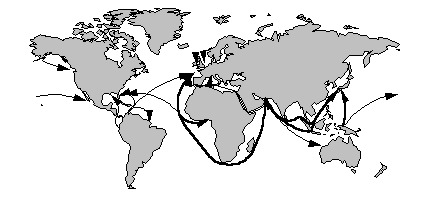
· Critical analysis of the market
requirements
The market requests are carefully analyzed both in the short and
long term to offer a balanced market fit during the whole
life-time. Specific market requests are validated and weighted
for their relative importance
· Matching of design specifications
with market requirements
Based on the market requirements the important design
specifications are extracted and balanced against technical and
economical constraints in close cooperation with the ship owner
and operator. These specifications are combined with already
available design specs.
· Clear definition of specifications
The next phase involves the extensive weighing and arranging of
all requirements, involving:
· Which criteria are not specified leaving 'grey areas'
· Which criteria are open to discussion and require further
definition
· Which criteria are too specific increasing the building price
· Consistency of specifications
(effective combinations)
After arranging the design spec the consistancy of requirement
and their relative influence are reviewed and corrected.
· Matching of design spec with standard
designs offered by shipyards
As last step in the analysis of the design the defined
specifications are matched with the standard tanker design
offered by the ship yards. Deviations from the spec need to be
analyzed and their relative importance weighted against increased
cost for specialities.
After defining the design specifications a number of design concepts are reviewed to analyze the specific pros and cons of every concept. In general, one design concept is used as base benchmark. Further one or two design variations are selected and their relative performance to the benchmark are determined. The design variation is limited to the relevant parameters only to achieve rapid and cost effective results. Other parameters remain unchanged.
A typical example are various design studies on different structural arrangements of the transverse web in VLCC's. The study was limited to the tank region only, leaving the forward and aft end of the vessel unchanged.
Tank arrangements are also subject to various studies in the Aframax size. Since the introduction of double hull tanker designs without longitudinal bulkheads operational stability has become an important subject. Both swash and watertight centreline bulkheads have been included.
After the selection of a specific design
concept, the design process moves into further detail. For this
phase IMC Shipping & Offshore Design offers the
following range of calculations modules: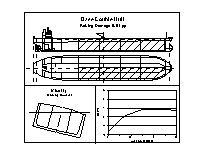
· Volume calculations
Based on external and internal hull parameters.
· Intact and Damage stability
calculations
Based on international tanker regulations and specific
operational requirements. Included are the longitudinal bending
and shear force calculations.
· Structural design calculations including FEC
Based on class requirements and operational life fatigue
requirement of the owner.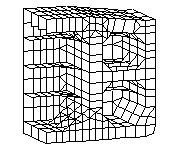
· Steel weight calculations
Based on detailed summation of all relevant structural material
and ship's components
· Resistance and powering calculations
Based on analyzed and their relative importance weighted against
increased cost for specialities.
· Life-time operational simulation
Based on an operational simulation of the vessels operational
voyages during its whole life-time, including the important
technical and economical parameters.
· Probabilistic outflow calculations
according to IMO 13F
Based on the probabilistic outflow calculation requirements
defined by IMO 13 F
IMC Shipping & Offshore Design
offers services to review designs offered by designers and ship
yards. In general a review will involve a study of the design
specifications (including the market), an analysis of the offered
design and a report containing practical recommendations.
The majority of design reviews focus on one or more detail areas,
e.g. design of pump-room in VLCC, but some include general
review, e.g. tank arrangement of Aframax.
The review can be based on provisional design data or can be
based on on-site inspection of a design during new-building or
conversion.
Tanker disasters have led to changes in the international MARPOL regulations and a large focus on the environmental performance of tanker designs. Both operational and accidental spills require further analysis and investigation. IMC has performed a wide range of outflow analysis for various tanker sizes and different tank arrangements, demonstrating significant consequences on the outflow and liability in case of accidents. Various outflow limiting devices, like hydrostatic balance and the ECO-Bulkhead have been reviewed.
Further analysis has focused on salvage consequences of the new
double hull designs and measures to limit the disastrous
consequences after a collision or grounding. Various systems,
like emergency cargo transfer have been reviewed.
IMC Shipping & Offshore Design is also involved in conversions and modifications of tankers. IMC participates in the tanker related design parameters and cooperates with other design specialists in the total design process. Typical examples are the participation in the conversion of a small product tanker to a shuttle tanker and the use of a standard double hull newbuilding as base for a FPSO. In both cases our staff has focused on the tank arrangement of the vessel and the implication of new requirements for the vessel on the tank arrangement.
The services presented above represent the largest part of our
activities. This does not mean that we are not interested in
tailor-made services. On the contrary; if your questions or
requirements do not fit into the topics listed above we urge you
to contact us for further information.